
save up to
2 hours daily
on dental notes and perio charting
Trusted by 10K+ dental professionals
Get 10% off
your first month
Complete, copyable clinical note templates for every common procedure – each with a filled-out sample. Use them as-is, or let Denti.AI Scribe write them automatically while you talk to your patient.
Every template, its filled-out sample, and a printable perio chart – sent to your inbox.
Showing 17 templates
Get the 17-template PDF pack to print for the operatory or share with your team. Free. We'll also send occasional documentation tips – unsubscribe anytime.
Across all 17 templates, the same elements keep showing up:
Every clinical note answers the same three questions a reviewer will ask later: why was this treatment needed, what exactly was done, and what happens next. Notes that answer all three stand up to insurance audits, board reviews, and the next clinician who opens the chart. Notes that don't get claims downgraded or denied.
Write the note the same day and specific to this patient – copied-forward text is one of the first things auditors look for. Then pick the template for your procedure above, or let Denti.AI Scribe write it from the appointment conversation.
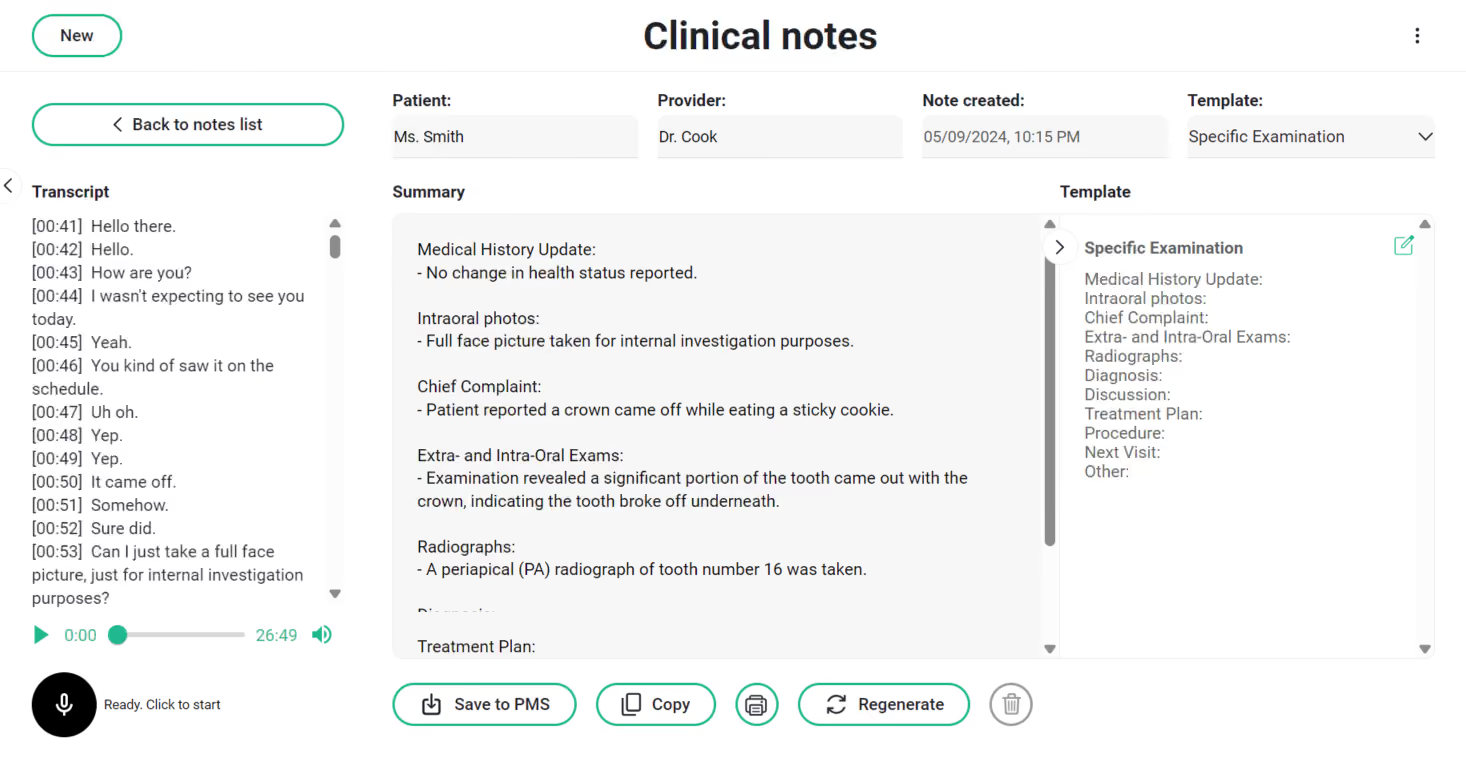
Denti.AI Scribe – real-time transcription and template-based notes
A SOAP note documents a patient visit in four parts: Subjective (what the patient reports), Objective (what you observe and measure), Assessment (your diagnosis), and Plan (treatment performed and next steps). It's the most widely used clinical note format in dentistry.
A good note is complete, specific, and written the same day. It should let another clinician pick up the case cold – and stand up to an insurance audit or board review years later.
The date and provider, reviewed medical history, the diagnosis and the evidence for it, consent with the specific risks discussed, anesthesia and procedure details, materials used, negative findings, post-op instructions, and the next visit.
Long enough to justify the diagnosis and describe the treatment precisely. Most procedure notes run 150–400 words. Length matters less than completeness.
D0140 – limited oral evaluation, problem focused. Use it when a patient comes in for a specific problem such as pain, swelling, or trauma. Routine check-ups for established patients are D0120 (periodic), and full baseline exams are D0150 (comprehensive). Bill radiographs and any palliative treatment separately.
Both are periodontal scaling and root planing, billed per quadrant. D4341 is four or more teeth in the quadrant; D4342 is one to three teeth. The note should state the tooth count per quadrant, along with the perio diagnosis and the probing depths, bleeding, and bone loss that support it.
D4346 is scaling in the presence of generalized moderate or severe gingival inflammation – full mouth, after an oral evaluation. It fits patients with inflamed, bleeding tissue but no attachment loss, where a prophy isn't enough and SRP isn't indicated. Many payers look for generalized bleeding – commonly 30% of sites or more – so record BOP as a percentage.
Prophylaxis is preventive cleaning for a periodontally healthy patient. Periodontal maintenance follows completed active perio therapy such as SRP, and the note must reference that history and site-specific findings. Mixing the two is a common audit trigger.
D7140 is an extraction by elevation and/or forceps. D7210 is a surgical extraction that requires removing bone and/or sectioning the tooth, including flap elevation if indicated. If the note doesn't describe the surgical step, expect a downgrade to D7140 on review.
Denti.AI Scribe is HIPAA compliant. Audio is encrypted in transit and at rest, and notes sync to your practice management system without leaving a compliant environment.
Yes. Scribe gives you granular control over templates and prompts, learns your preferred format and terminology, and DSOs can standardize dictionaries at the organization or location level.
Yes – every template is free to copy and adapt for your practice. Each template page has a printable PDF, and you can get all 17 in one PDF pack on this page.
CDT codes are maintained by the ADA. Confirm codes against the current CDT edition and each payer's policy.